A heat pump can reduce your home’s reliance on natural gas and provide efficient heating for years to come, but the upfront cost is a real consideration. This guide to heat pump grants explains the support currently available to homeowners in England, what you may need to contribute yourself, and how to avoid committing to a system that is not right for your property.
For most eligible households in Hertfordshire, the main source of funding is the Boiler Upgrade Scheme. It can make a significant difference to the cost of an air source heat pump, but it is not an automatic discount and it will not suit every home. A proper survey should come before any firm decision.
The Boiler Upgrade Scheme explained
The Boiler Upgrade Scheme, often called BUS, is a government grant designed to help property owners replace existing fossil-fuel heating with low-carbon heating. For an eligible air source heat pump or ground source heat pump installation in England and Wales, the grant is currently worth up to £7,500.
The grant is applied for by the installer, not paid into your bank account. In practical terms, it is deducted from the agreed installation price. Your quote should clearly show the full cost of the work, the grant value and the balance you will pay. That clarity matters. You should know exactly what is included before work begins, from the heat pump and cylinder to pipework alterations, controls and commissioning.
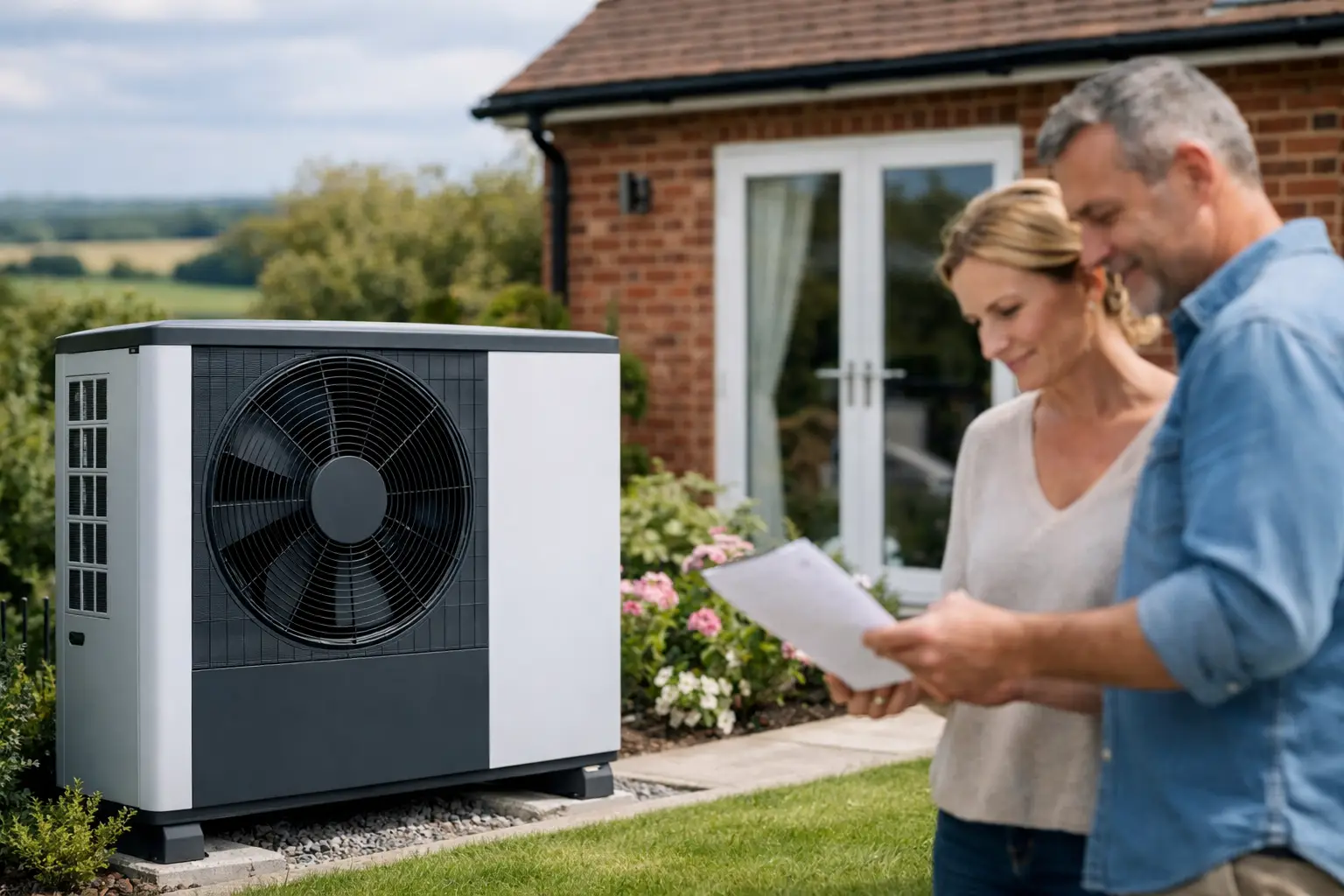
Air source heat pumps are the usual choice for homes locally because they are generally less disruptive and less expensive to install than ground source systems. They take heat from the outside air and use electricity to raise it to a useful temperature for your heating and hot water. They work best when the entire system has been designed around the property, rather than simply fitted in place of a boiler.
Who can apply for a heat pump grant?
Eligibility is based on both the property and the installation. In broad terms, you must own the property in England or Wales, whether it is your home, a second property or a qualifying rental property. Landlords can apply, which may be particularly relevant where an ageing gas boiler is becoming unreliable or where a property needs a longer-term heating upgrade.
The property generally needs a valid Energy Performance Certificate issued within the last ten years. It must not have outstanding recommendations for cavity wall insulation or loft insulation. This requirement exists because a heat pump should not be used to compensate for avoidable heat loss. In some cases, insulation work may be the sensible first step before progressing with a heat pump installation.
You will usually be unable to receive the grant if your property has already received public funding for a heat pump. There are also restrictions around new-build homes, although self-build properties may be treated differently. Planning and technical requirements can also apply, especially where a property is listed, in a conservation area or has limited outdoor space.
Rules and funding levels can change, so eligibility should be checked at the quotation stage. A professional installer can assess the property, confirm whether the grant route appears suitable and explain the paperwork required before you proceed.
You do not have to be off the gas grid
A common misunderstanding is that heat pump grants are only for homes without a gas connection. That is not the case. Many eligible applicants are replacing a gas boiler, particularly when it is near the end of its useful life or when they are carrying out wider renovation work.
That said, replacing a modern, efficient gas boiler with a heat pump is a bigger decision than a like-for-like boiler swap. The grant helps, but you should still compare the complete cost, expected running costs, available space and the work your home may need.
What the grant does and does not cover
The £7,500 grant can reduce the headline cost substantially, but it is not a promise that every installation will cost the same after funding. The remaining amount depends on your home, your existing heating system and the specification needed to deliver dependable warmth.
A typical quotation may include the heat pump unit, hot water cylinder, controls, a system clean where appropriate, new valves, alterations to pipework, electrical work and commissioning. Some properties may also need radiator upgrades because heat pumps commonly operate at lower flow temperatures than a traditional boiler. Larger or better-specified radiators can release enough heat at those lower temperatures to keep rooms comfortable.
Additional works are not a reason to abandon the idea, but they should never appear as a surprise. Ask for a detailed fixed quotation that explains what is included, what assumptions have been made and whether any possible extras have been identified. You pay what you are quoted. No hidden costs should be the standard.
Is your home ready for a heat pump?
A heat pump is not just an outdoor unit replacing a boiler. It is part of a whole heating system. The right installer will start by calculating how much heat each room loses, not by recommending a model based only on the number of bedrooms.
A heat-loss survey considers insulation levels, windows, floor area, room use and ventilation. This helps determine the heat pump size and whether radiators, pipework or the hot water cylinder need attention. An oversized heat pump can cycle inefficiently, while an undersized one may struggle during colder weather. Accurate design is what protects comfort and running costs.
Space is another practical factor. You will need a suitable location outside for the unit, with enough room for airflow and access for servicing. Inside, most homes need space for a hot water cylinder, usually in an airing cupboard, utility room or similar area. Flats and compact properties can still be possible, but the layout needs careful assessment.
Noise is often raised by homeowners before installation. Modern air source heat pumps are designed to operate quietly, but location remains important. The unit should be positioned with neighbours, boundaries, bedroom windows and available clearance in mind. Most installations fall under permitted development rules, but this must be checked for the individual property.
Choosing an installer without losing the grant
To access the Boiler Upgrade Scheme, the installation must be carried out by an eligible installer. Do not assume every heating engineer or every heat pump quote qualifies. Ask directly whether the installer is approved to apply for the scheme and whether they will manage the application on your behalf.
It is also worth asking how the system will be designed, not just what make of heat pump will be fitted. A dependable proposal should cover the room-by-room heat-loss calculation, radiator assessment, cylinder size, controls, electrical requirements and expected disruption. You should also receive clear information about manufacturer warranties, workmanship guarantees, servicing and who to call if you need support after installation.
At Walsh Plumbing & Heating, the focus is on making major heating decisions easier to manage: a clear survey, straightforward advice and a fixed quote before work starts. Heat pump suitability is assessed honestly. If a heat pump is not the best fit for your property or budget, you should be told that early.
Other support worth checking
The Boiler Upgrade Scheme is the key grant for many Hertfordshire homeowners, but it is not the only route that may be relevant. Some households may qualify for energy-efficiency support through local authority or supplier-led schemes, particularly where income, benefits or a lower EPC rating are factors. These schemes can change by area and funding round, so availability is not guaranteed.
If you live in Scotland or Northern Ireland, different programmes apply. This guide is focused on England and Wales, where the Boiler Upgrade Scheme is the most relevant national heat pump grant. For a property outside those areas, seek advice based on the nation where the home is located rather than relying on an England-specific quote.
Start with the home, not the grant
The grant is valuable, but it should not be the only reason to install a heat pump. Start with a survey of your property, the condition of your existing system and how you use your heating and hot water. A well-designed system can offer efficient, steady warmth and a practical route away from an ageing boiler; a rushed installation can create unnecessary cost and frustration.
If you are considering the move, gather your EPC, note any insulation work already completed and arrange a proper assessment. Clear answers at that stage will make the grant, the budget and the next decision far easier to manage.