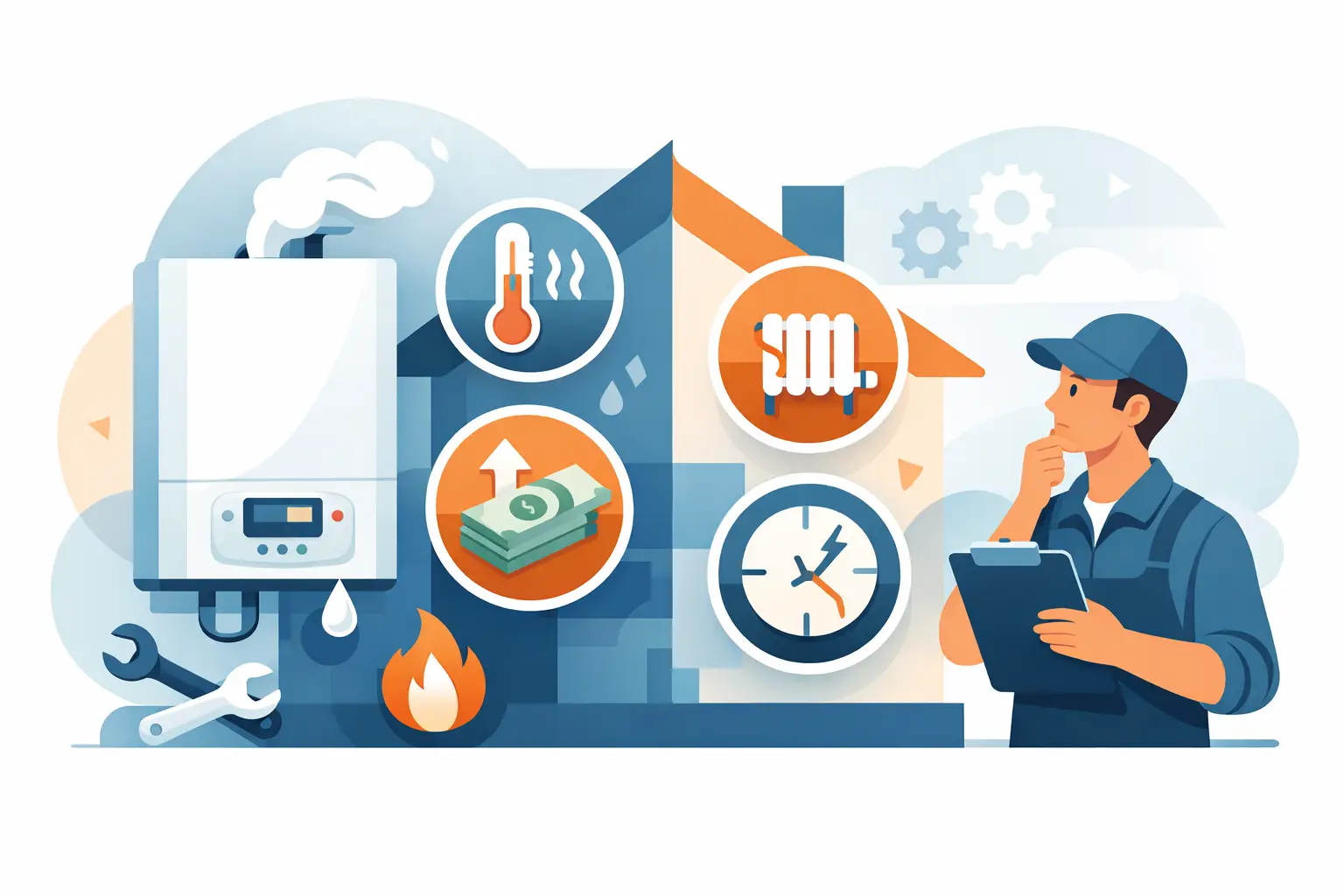
Cold radiators on a January morning usually focus the mind. If you are starting to notice the signs boiler needs replacing rather than simply needing another repair, it is worth acting early. Leaving it too long can mean higher gas bills, more call-outs, and the real risk of losing heating or hot water when you need it most.
For many homeowners and landlords, the difficult part is knowing where the line is. Boilers do fail suddenly, but more often they give plenty of warning first. The challenge is recognising those warnings and deciding whether a repair is still sensible or whether replacement is now the better investment.
The clearest signs your boiler needs replacing
1. It is breaking down more often
An occasional fault does not automatically mean the boiler is finished. Components wear out, sensors fail, and some repairs are straightforward. But if you are calling an engineer every few months, the pattern matters more than the individual issue.
Frequent breakdowns usually point to a boiler that is becoming unreliable as a whole, not just suffering from one isolated problem. Even if each repair is manageable on its own, the total cost, inconvenience, and stress add up quickly. For busy households and small commercial premises, repeated loss of heating and hot water can become far more expensive than replacing the unit.
2. Your energy bills keep climbing
If your usage has stayed broadly similar but your gas bills continue rising, your boiler may no longer be running efficiently. Older boilers have to work harder to produce the same level of heat, especially if internal parts are worn or the system has become less responsive over time.
A modern A-rated condensing boiler can make a noticeable difference to running costs, particularly when installed and set up correctly for the property. That does not mean every high bill points straight to replacement. Insulation, controls, and general system condition also matter. But if the boiler is older and your bills are steadily worsening, replacement becomes a practical conversation rather than just a sales idea.
3. The boiler is 12 to 15 years old or more
Age on its own is not always the deciding factor, but it matters. Many boilers can last well with proper servicing, yet once a unit reaches 12 to 15 years old, you are more likely to see reliability issues, lower efficiency, and harder-to-source parts.
This is especially relevant if the boiler was fitted to an older standard and lacks the performance of newer models. At that point, you are not just comparing repair cost against replacement cost. You are also comparing an ageing system with a newer one that may come with a lengthy manufacturer guarantee, improved controls, and better long-term dependability.
4. Some parts are obsolete or difficult to source
One of the most practical signs your boiler needs replacing is when replacement parts are no longer readily available. Engineers can only repair what they can source safely and reliably. If a key component is obsolete, you may face delays, higher costs, or limited repair options.
Even when a part can still be found, it may not make financial sense to fit it to a boiler nearing the end of its serviceable life. This is where honest advice matters. A good engineer should tell you clearly whether a repair is worthwhile or whether you are close to throwing good money after bad.
Performance problems that should not be ignored
5. Heating and hot water are inconsistent
If your boiler struggles to keep up, takes longer to heat water, or leaves radiators patchy and slow to warm, there may be a deeper issue than everyday wear and tear. Sometimes the problem sits elsewhere in the system, such as sludge in the pipework, poor controls, or circulation faults. But if the boiler itself is ageing and these performance issues are becoming more frequent, replacement may be the right fix.
This is one of those areas where it depends. A relatively modern boiler with a system issue might be worth repairing. An older boiler with recurring performance complaints often points towards replacement as the more reliable option.
6. It is making unusual noises
Boilers are not silent, but they should not be banging, whistling, gurgling, or kettling loudly. Those sounds can indicate limescale build-up, pressure issues, pump problems, or overheating inside the heat exchanger.
In some cases, the issue can be resolved with repair work or system cleaning. In others, especially with older units, the noise is a symptom of wider wear. If the boiler has already had multiple repairs and is starting to sound rough in operation, that is usually a sign the system is under strain.
7. You no longer trust it
This may sound less technical, but it matters. If you are constantly resetting the boiler, worrying when you leave the house, or wondering whether it will get through another winter, reliability has already become a problem.
Heating should not be something you have to second-guess every week. For landlords, reliability matters even more because tenant expectations, legal duties, and response times all add pressure. For homeowners, replacing a failing boiler before it becomes an emergency can remove a lot of stress and give you more control over timing and cost.
Repair or replace? How to make the call
There is no single rule that fits every boiler. A newer appliance with one identifiable fault is often worth repairing. An older boiler with repeated issues, expensive parts, and poor efficiency usually points in the opposite direction.
A useful way to look at it is this: if the repair is significant and the boiler is already past its best, ask what that money really buys you. If the answer is only a short-term fix with no guarantee against the next fault, replacement may be the wiser route.
By contrast, if the boiler is still within a reasonable age range, has been serviced properly, and the problem is clearly isolated, repair can still be the right choice. What customers generally want is not the cheapest answer on the day. They want the option that gives them the best value and least disruption over the next several years.
Why waiting can cost more
Putting off a replacement often feels sensible because it avoids a larger immediate spend. The problem is that delay can create a more expensive situation later. Emergency breakdowns tend to happen at the worst time, and urgent decisions are rarely the most cost-effective ones.
You may also be paying more each month in wasted energy while dealing with unreliable performance. Add in repair bills, lost time, and the inconvenience of repeated call-outs, and the real cost of keeping an old boiler going can become surprisingly high.
Planning a replacement gives you more choice. You can compare suitable models, look at warranty length, consider finance if needed, and have the work carried out at a time that suits you rather than in the middle of a heating crisis.
What to expect from a boiler replacement
A proper replacement should start with a clear assessment of your property, hot water demand, existing system, and budget. Not every home needs the same boiler size or setup, and fitting the wrong appliance can create problems of its own.
This is why fixed quotes, transparent advice, and accredited installation matter. You should know what you are paying for, what warranty is included, and whether any system improvements are recommended alongside the new boiler. In many cases, a well-planned replacement delivers quieter operation, lower running costs, and far better peace of mind from day one.
For customers across Hertfordshire and surrounding areas, that reassurance matters just as much as the appliance itself. Walsh Plumbing & Heating focuses on making the process straightforward, with clear pricing, professional installation, and options that suit the property rather than pushing a one-size-fits-all answer.
When to book an assessment
If you have noticed one of these warning signs, there is no need to panic. But there is a strong case for arranging an assessment before the boiler forces the issue. The earlier you deal with it, the more likely you are to avoid disruption, rushed choices, and avoidable expense.
A reliable heating system is not just about comfort. It is about safety, predictable costs, and knowing your home or rental property is properly looked after. If your boiler is showing its age, the smartest move is often not to wait for complete failure, but to replace it while you still have time to do it properly.