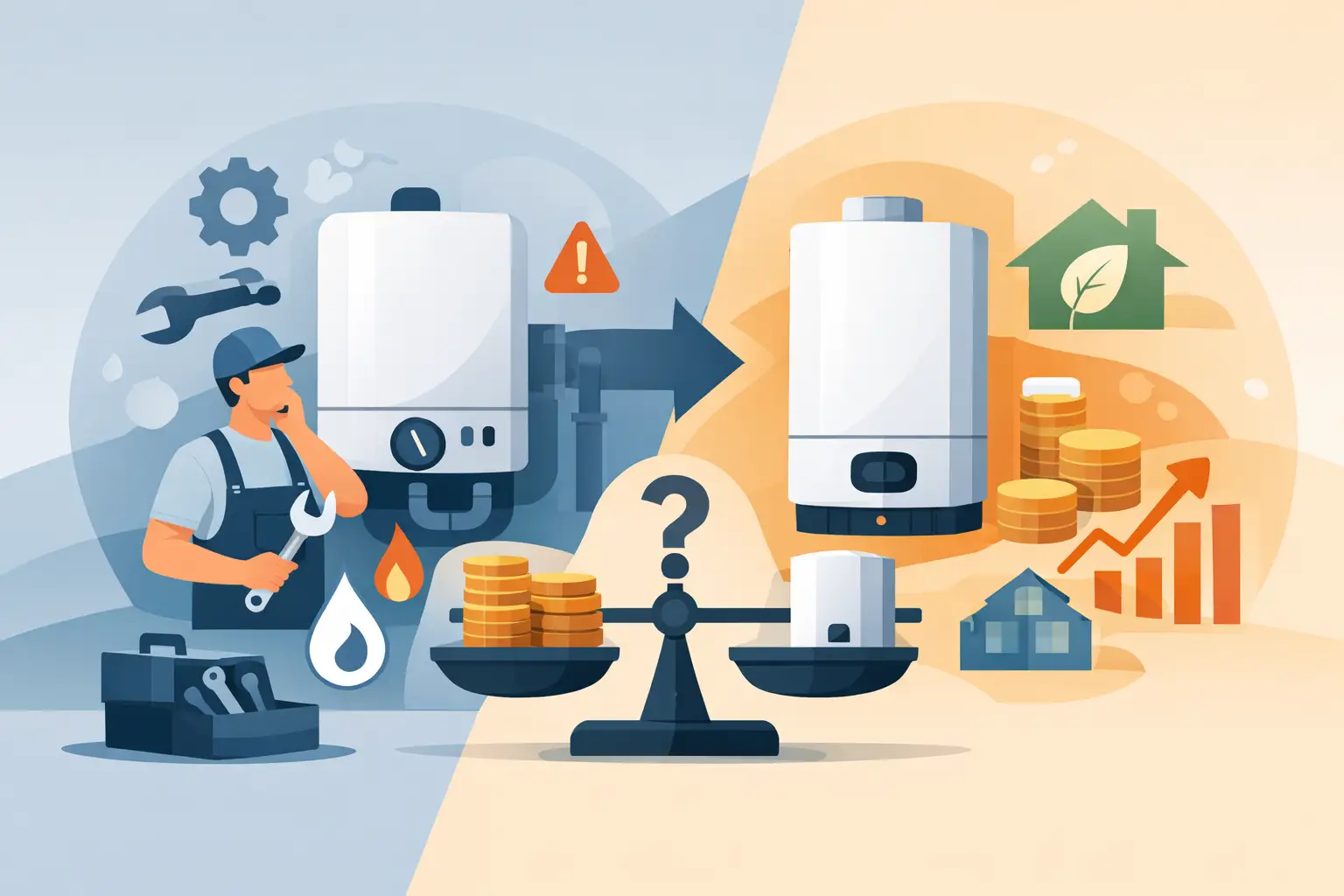
When your boiler stops behaving properly, the question is rarely academic. You want the heating back on, the hot water running, and a clear answer on whether boiler repair or replacement makes better financial sense. That decision can feel urgent, especially in winter, but it should still be based on facts – not guesswork.
A good engineer should make this simple. You need to know what has failed, whether the fault is isolated or part of a bigger pattern, what the repair is likely to cost, and how much life the boiler realistically has left. Once those points are clear, the right choice usually becomes much easier.
Boiler repair or replacement: what actually matters?
The biggest factor is not just the cost of today’s fault. It is the overall value of putting more money into your current system.
A boiler that is five years old, has been serviced regularly, and has developed a straightforward issue such as a pump, valve or ignition fault is often well worth repairing. If the unit is otherwise in sound condition, a professional repair can restore reliability without pushing you towards unnecessary replacement.
The picture changes when the boiler is older, increasingly unreliable, or showing signs of broader wear. If you are calling for repeated breakdowns, losing confidence in the system, or facing expensive parts on an ageing appliance, replacement starts to look less like a major cost and more like a sensible investment.
This is where honest advice matters. The cheapest option today is not always the lowest-cost option over the next three to five years.
When a boiler repair makes sense
Repair is often the right route when the boiler is still within a reasonable age range and the fault is clearly identifiable. Modern gas boilers can be very dependable when maintained properly, and many common issues are fixable without major disruption.
If your boiler is under 8 to 10 years old, has a good service history, and the heat exchanger and core components remain in good condition, a repair is usually worth considering first. The same applies if spare parts are readily available and the repair cost is proportionate to the value of the appliance.
It also matters how the boiler has performed up to now. A one-off fault is different from a pattern. If this is the first meaningful issue in years, repairing it may be the most practical option.
For landlords and small commercial operators, repair can also be the right short-term decision where the system is otherwise compliant and dependable. That said, patching up a failing boiler just to delay a replacement can create more disruption later, especially for tenants or staff relying on consistent heating and hot water.
When boiler replacement is the smarter choice
There are certain situations where replacement is often the better call, even if a repair is technically possible.
Age is a major one. Once a boiler moves beyond 10 to 15 years old, efficiency tends to drop, parts can become harder to source, and repeat faults become more likely. You may still be able to repair it, but that does not always mean you should.
A replacement is often worth serious thought if your boiler is breaking down regularly, making unusual noises, leaking, struggling to maintain pressure, or failing to heat your property evenly. These are signs that the problem may not be limited to a single component.
Higher running costs also matter. Older boilers are typically less efficient than current models, so even if they still work, they may be costing more than necessary to run. Over time, that gap can become significant, particularly in larger homes or properties with heavier heating demand.
Then there is peace of mind. A new boiler can give you dependable performance, lower energy use, modern controls, and the reassurance of a long manufacturer-backed guarantee. For many households, that reliability is just as important as the headline installation cost.
The cost question: repair now or spend more once?
Most people naturally focus on the immediate bill. That is understandable. But the better question is what your total spend is likely to be if you keep the current boiler.
For example, a moderate repair bill on a relatively modern boiler may be good value. The same bill on a 14-year-old appliance with previous faults is a different story. If another major component fails six months later, your money starts disappearing into a system with limited life left.
A useful rule of thumb is to look at repair cost alongside age and reliability. If the repair is expensive and the boiler is already older, replacement often makes more sense. If the repair is modest and the boiler still has strong years ahead of it, fixing it is usually reasonable.
It also helps to consider the hidden costs of delay. Emergency breakdowns often happen at the worst time. You may face time off work, disruption to tenants, cold rooms, and the stress of making a rushed decision when the system finally gives up.
Signs you should not ignore
Some boiler problems are inconvenient. Others can indicate a system that is reaching the end of the road.
If your boiler keeps locking out, loses pressure repeatedly, produces inconsistent hot water, or takes longer and longer to heat the property, it needs proper assessment. Banging, kettling, or other unusual noises can point to internal wear, sludge issues, or circulation problems. Leaks should never be ignored, especially where they suggest corrosion or failing seals around ageing components.
A yellow flame rather than a crisp blue one should always be checked by a Gas Safe registered engineer. Safety comes first with any gas appliance.
Even if the boiler can be made operational again, the wider condition of the system still matters. Sometimes the fault is not one dramatic failure but a collection of smaller warning signs telling you the appliance is no longer a dependable long-term option.
Boiler repair or replacement for older systems
Older systems need especially careful judgement. Many homeowners are understandably reluctant to replace a boiler that still partly works, but age changes the calculation.
With an older appliance, parts availability becomes less certain, repairs may take longer, and efficiency can be poor compared with a modern condensing model. You may also find that one repair simply exposes the next weak point. That can leave you spending money in stages while still ending up with a replacement later.
On the other hand, not every older boiler needs to be condemned immediately. Some have been very well maintained and can still justify a targeted repair. The key is whether the system is structurally sound and whether the cost of keeping it running is still sensible.
That is why clear advice matters more than blanket rules. A trustworthy engineer should explain the trade-off honestly, including where replacement is advisable but not yet unavoidable.
Think beyond the boiler itself
A replacement decision should never be based on the box on the wall alone. Your wider heating system affects performance too.
If your radiators heat unevenly, the controls are outdated, or the system water is contaminated, these issues can reduce efficiency and strain the boiler. In some cases, homeowners replace the appliance but keep underlying system problems that continue to affect performance.
A proper survey should look at the boiler size, property demand, hot water usage, flue position, controls, and the condition of the existing pipework and radiators. This is how you avoid paying for a new boiler that is poorly matched to the property.
For customers looking at replacement, this is also the right time to ask about warranty length, expected running costs, and finance options. A fixed quote and clear scope of work make a big difference when the purchase feels stressful.
What good advice looks like
You should never feel pushed into boiler replacement simply because a breakdown is inconvenient. Equally, you should not be sold a repair that delays the inevitable and leaves you paying twice.
Good advice is transparent. It explains the fault in plain English, sets out whether repair is reliable or just temporary, and gives you a clear price before work begins. You pay what you are quoted. No hidden costs.
That is the standard homeowners and landlords should expect from any heating company. At Walsh Plumbing & Heating, that straightforward approach is central to how customers are supported through urgent faults and planned upgrades alike.
If you are weighing up boiler repair or replacement, the best next step is not to guess. Get the boiler properly assessed, ask direct questions, and look at the decision in terms of reliability, safety, efficiency and total cost – not just today’s invoice.
The right choice is the one that leaves you warm, confident, and not worrying about the next breakdown.