A boiler failure rarely happens at a convenient time. One minute you are running a bath or turning the heating up, and the next there is no hot water, cold radiators and an unfamiliar code on the display. Knowing what to do if boiler stops working can help you stay safe, rule out a simple issue and get the right help without delay.
Before trying anything, remember that gas boiler repairs are not a DIY job. You can carry out a few basic external checks, but never remove the boiler casing or interfere with gas, electrical or sealed-system components. If in doubt, stop and call a Gas Safe registered engineer.
Start with safety, especially if you smell gas
If you can smell gas, hear a hissing sound near the boiler or gas meter, or suspect a gas leak, do not investigate the appliance. Turn off the gas supply at the emergency control valve only if it is safe to do so, open doors and windows, leave the property and call the National Gas emergency number on 0800 111 999.
Do not use electrical switches, smoke, light matches or create a flame. If anyone has headaches, dizziness, nausea or feels unusually unwell, get into fresh air straight away and seek urgent medical advice. These can be signs of carbon monoxide exposure. A working audible carbon monoxide alarm near, but not directly beside, a gas appliance provides valuable protection, but it never replaces regular boiler servicing.
If there is no smell of gas and no immediate danger, you can move on to a few safe checks.
What to do if your boiler stops working: safe checks
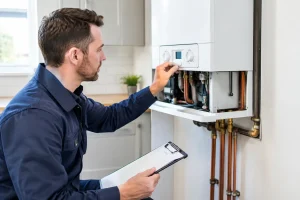
Begin with the boiler display. Most modern boilers show a fault code, warning symbol or flashing light when they lock out. Write down the code, the boiler make and model, and when the problem began. This gives your engineer a useful starting point and can speed up diagnosis.
Next, check whether the issue is limited to your boiler. Look at the consumer unit to see whether a circuit has tripped, and make sure the boiler’s fused spur is switched on. If you have a prepayment gas meter, check that there is credit available. It sounds obvious, but power interruptions, a tripped switch or an empty meter can look very much like a boiler fault.
Then look at your heating controls. Confirm the programmer is set correctly, the thermostat is calling for heat and the batteries in a wireless thermostat have not failed. Set the thermostat a few degrees above the current room temperature and allow a few minutes for the boiler to respond. If hot water works but heating does not, the controls, thermostat, diverter valve or central-heating side of the system may be involved.
Check the system pressure
Many sealed heating systems need a cold pressure of roughly 1 to 1.5 bar. The correct range varies by boiler, so always follow the instructions for your model. If the gauge is below 1 bar, the boiler may shut down to protect itself.
Some homeowners can safely repressurise their system using the filling loop, provided they know how and the manufacturer’s guidance allows it. Add water slowly and stop at the recommended pressure. Never overfill the system. If pressure repeatedly drops, do not keep topping it up. A leak, failed expansion vessel or pressure-relief issue may need professional attention.
Pressure that is too high can also cause trouble. If it rises significantly when the heating is on, or water is discharging from an external copper pipe, arrange an engineer visit rather than attempting a repair yourself.
Consider cold weather and frozen condensate pipes
During a cold Hertfordshire winter, a frozen condensate pipe is a common reason for a condensing boiler to stop. The condensate pipe usually runs from the boiler to an outside drain. If it has frozen, the boiler may display a lockout code and refuse to restart.
Only attempt to thaw an accessible external pipe using warm water, not boiling water, or a warm cloth. Take care on icy surfaces and never dismantle pipework. Once thawed, a single boiler reset may restore operation. If the pipe freezes more than once, it may need improved insulation, a different route or a correctly sized external section to prevent a repeat problem.
Should you reset a boiler?
A reset can clear a one-off lockout after a brief power cut, low-pressure correction or frozen condensate issue. Use the reset button or follow the method shown in your boiler manual. Do it once, then wait to see whether the boiler fires up normally.
Avoid repeatedly resetting a boiler. A lockout is the appliance telling you something needs attention. Repeated resets can mask an underlying problem, such as ignition failure, a faulty sensor, poor circulation or an issue with the gas supply. If it locks out again, leave it off and book a qualified engineer.
Signs you need a Gas Safe engineer now
Some faults cannot and should not be resolved by a homeowner. Contact a Gas Safe registered engineer if the boiler will not restart after the basic checks, has no display, keeps losing pressure, leaks water, makes banging or whistling noises, or shows a persistent fault code.
You should also call for help if only some radiators heat up, the hot water runs hot and cold, or the boiler cycles on and off unexpectedly. These issues might relate to sludge in the system, a pump problem, a blocked heat exchanger, a failing valve or controls that need testing. The correct repair depends on the diagnosis, which is why clear fault-finding matters.
For landlords, an inoperative boiler also needs prompt attention. Tenants must have access to heating and hot water, and gas appliances must be maintained safely. Keep records of reported faults, engineer visits and completed repairs alongside your current Gas Safety Record.
What an engineer will check
A professional boiler repair visit should be methodical, not guesswork. A Gas Safe engineer will assess the appliance safely, check the fault history, inspect visible components and test the boiler’s operation. They may check gas pressures, combustion, ignition, flue performance, circulating components, system pressure and controls, depending on the symptoms.
The outcome may be a straightforward repair, such as replacing a worn part or correcting a system issue. In other cases, especially with an older boiler that breaks down frequently, replacement can be the more sensible long-term option. It depends on the boiler’s age, condition, repair cost, efficiency and the availability of parts.
A good engineer should explain the options in plain English before work starts. Ask whether the repair is likely to provide a lasting solution, what guarantee applies to the work, and whether any wider system improvements are advisable. You should know the expected cost before agreeing to proceed. No hidden costs, no pressure.
When replacement may be better than another repair
A repair is often worthwhile on a well-maintained boiler with a clear, isolated fault. However, if your boiler is approaching the end of its working life, parts are becoming difficult to source or repair bills are building up, replacement deserves consideration.
A new energy-efficient boiler can improve reliability and give you a longer manufacturer guarantee, often up to 12 years when installed under the right scheme. It also gives an engineer the opportunity to assess your controls, radiators, pipework and hot-water demand, rather than simply fitting a like-for-like appliance that may not suit the property.
For households considering lower-carbon heating, a heat pump may also be worth discussing. It is not the right answer for every home, and suitability depends on insulation, heat loss, radiator sizing and available space. A proper survey will give you an honest view of the practical choices.
Reduce the risk of another breakdown
Annual boiler servicing is the simplest way to reduce avoidable failures. A service checks safe operation and helps identify worn components or system concerns before they leave you without heat. It is particularly worthwhile before winter, when heating systems work hardest and repair demand rises.
Keep the area around the boiler clear, do not cover ventilation openings and pay attention to small changes, such as new noises, slow hot-water delivery or pressure loss. Addressing these early is usually less disruptive than waiting for a complete breakdown.
If your boiler has stopped working and the safe checks have not resolved it, do not spend hours guessing. Walsh Plumbing & Heating can assess the fault, explain your options clearly and help restore reliable heating and hot water with professional, Gas Safe workmanship.