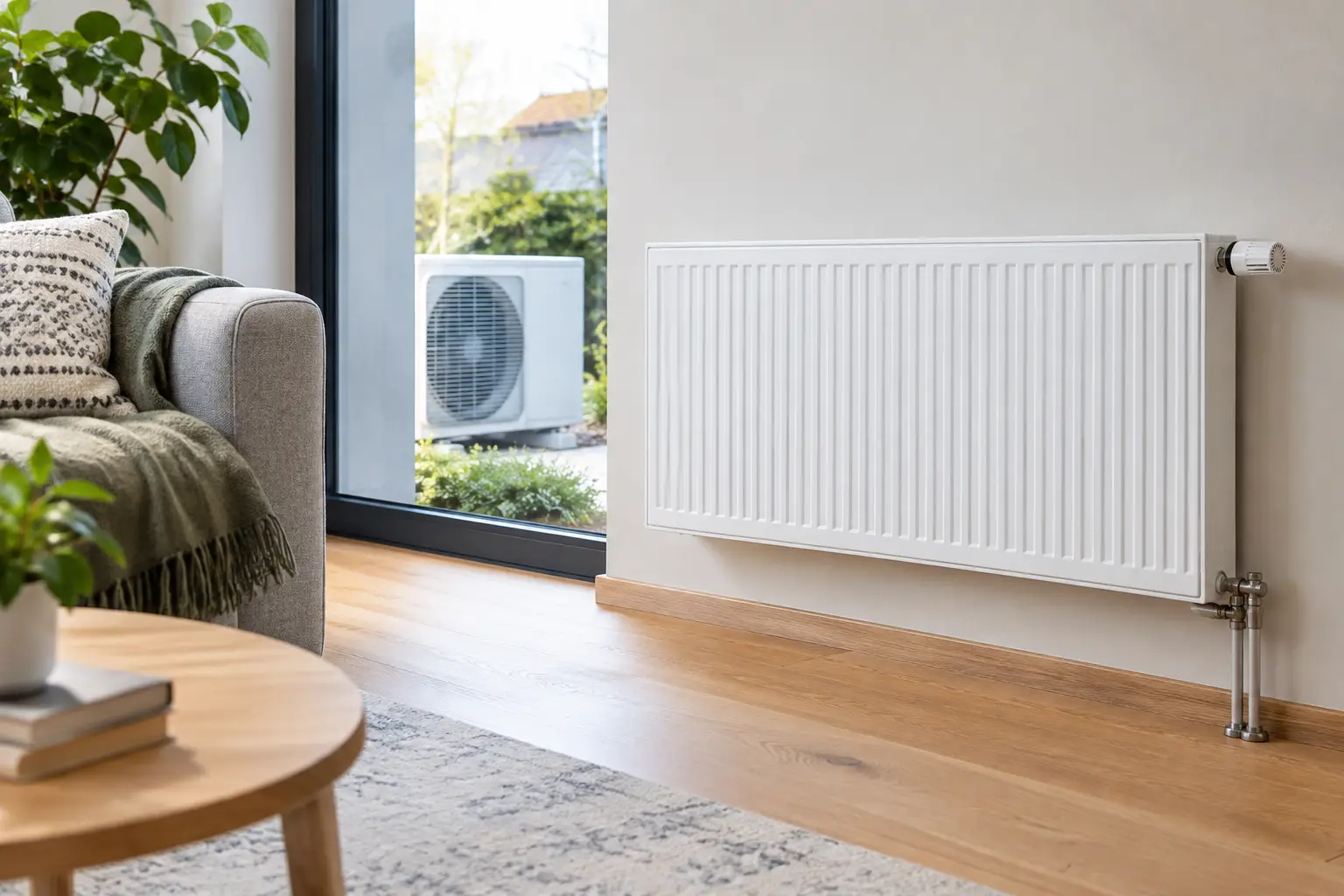
A heat pump can only deliver the comfort you expect if your radiators can release enough heat into each room. That is why choosing the best radiators for heat pumps is not simply a case of buying the largest models available. The right choice depends on your home’s heat loss, insulation, pipework, preferred room temperatures and the flow temperature your system will run at.
For many Hertfordshire homeowners, existing radiators can be retained in some rooms and upgraded in others. A proper survey is the starting point. It gives you a heating system designed around your property, rather than a one-size-fits-all answer.
Why heat pumps need the right radiator size
Gas boilers commonly send water around a heating system at a higher temperature than an air source heat pump. A heat pump works most efficiently when it can operate at a lower flow temperature, often around 35-55°C depending on the property and system design.
Lower-temperature water still heats your home well, but each radiator gives out less heat than it would with a traditional high-temperature boiler system. If a radiator was only just large enough before, it may struggle to warm the room on a cold day when connected to a heat pump.
This does not mean that every radiator must be replaced. A well-insulated room with a generously sized existing radiator may already be suitable. Smaller radiators in older, colder rooms are more likely to need upgrading. The aim is to ensure every room reaches its target temperature without forcing the heat pump to work harder than necessary.
How to choose the best radiators for heat pumps
The best option is the radiator that provides the required heat output at your system’s planned flow temperature. That output must be based on a room-by-room heat loss calculation, not solely on the size of the room or the radiator currently fitted.
A professional heat loss assessment considers the walls, windows, floor, roof, insulation levels, ventilation and the room’s intended use. A north-facing lounge with large glazing, for example, has very different requirements from a small, insulated upstairs bedroom.
It also accounts for the temperature you want in each space. Living rooms are typically designed warmer than bedrooms, while bathrooms often need a little more heat because of tiled surfaces and the comfort expected after a shower.
Larger panel radiators
For many homes, larger steel panel radiators are the most practical and cost-effective answer. A Type 22 radiator, with two panels and two sets of convector fins, can deliver considerably more heat than a single-panel model of the same width and height.
Increasing the width or height of a radiator can also raise output without dramatically changing the appearance of the room. In some cases, a replacement can fit in the same location using only modest alterations to pipework. These radiators are familiar, reliable and work quietly, which makes them a strong choice for bedrooms, lounges and hallways.
The trade-off is wall space. In compact rooms, a larger radiator may not be practical, particularly where furniture, doors or window positions limit the available area.
Low-temperature radiators
Some radiators are sold specifically as low-temperature or heat pump radiators. These are generally designed with a large surface area, enhanced convection or integrated fans to deliver stronger output at lower water temperatures.
They can be a useful option where a standard larger radiator will not fit. However, the label alone does not guarantee suitability. Always compare the manufacturer’s heat output at the actual design flow temperature, rather than relying on a headline figure quoted at a higher temperature difference.
A radiator’s output can look impressive in a brochure but be much lower at 45°C flow than at 75°C. This is where careful system design protects you from disappointment later.
Fan-assisted radiators and convectors
Fan-assisted radiators, sometimes called fan convectors, use small electric fans to move air through the unit and increase heat output. They can be particularly effective in rooms where wall space is limited, such as kitchens, extensions and converted garages.
They are compact and can respond quickly, but they require an electrical supply and produce a small amount of fan noise. Quality models are quiet in normal operation, although they will not suit every household’s preference. They also need occasional cleaning to prevent dust affecting performance.
Underfloor heating and mixed systems
Underfloor heating is not a radiator, but it deserves consideration when planning a heat pump installation. Its large surface area means it can work efficiently at very low water temperatures. It is often an excellent choice for new extensions, ground floors being renovated or new-build properties.
A mixed system can work well too. You may have underfloor heating downstairs and correctly sized radiators upstairs. What matters is that the system is designed to balance flow temperatures, controls and heat output properly. Adding underfloor heating without considering the rest of the system can create unnecessary complexity.
Do you need to replace every existing radiator?
Not necessarily. It depends on the calculations. Existing radiators may be suitable where they are oversized, where insulation has been improved, or where the room has a low heat demand. Reusing suitable radiators can reduce installation costs and avoid needless disruption.
However, retaining undersized radiators simply to save money can be a false economy. Your installer may need to run the heat pump at a higher flow temperature to compensate, which can reduce efficiency and increase running costs. The room may also feel slow to warm up or fail to reach temperature during colder weather.
The sensible approach is targeted upgrades. Replace what needs replacing, retain what performs well, and make decisions from measured heat loss rather than assumptions.
Radiator output figures: what homeowners should check
Radiator output is usually shown in watts. When comparing products, make sure the output is stated at the correct temperature difference, often written as Delta T or ΔT.
Traditional radiator specifications are often quoted at ΔT50, which broadly reflects a higher-temperature boiler system. Heat pumps commonly need radiators assessed closer to ΔT30 or ΔT35, depending on the design temperatures. A radiator rated at 2,000 watts at ΔT50 will provide substantially less heat at ΔT30.
This is one of the most common causes of confusion when homeowners buy radiators independently. Two radiators that appear similar can perform very differently at lower water temperatures. Your installer should clearly explain the output required for each room and the flow temperature used in the design.
Insulation, controls and pipework matter too
The best radiator upgrade cannot compensate for excessive heat loss through an uninsulated loft, draughty windows or poorly sealed doors. Improving insulation may reduce the size of radiator required and help the heat pump run at lower, more efficient temperatures.
Controls are equally important. Heat pumps generally work best with steady, consistent operation rather than frequent sharp changes. Weather compensation controls adjust the system’s flow temperature in response to outdoor conditions, helping to maintain comfort efficiently. Thermostatic radiator valves can still be useful for room-by-room adjustment, but they should be set up as part of the wider heating design.
Pipework should also be assessed. Older systems may need cleaning, flushing or alterations to ensure the water can circulate correctly through larger radiators. A clean system protects the heat pump and supports reliable long-term performance.
What a proper heat pump radiator survey should include
Before recommending radiator changes, an experienced installer should inspect the property and explain the available options in plain language. The survey should include room-by-room heat loss calculations, checks on existing radiators and pipework, insulation considerations, and a clear proposed flow temperature.
You should also receive a straightforward quotation showing what is included. This makes it easier to compare options and avoids the uncertainty of discovering essential work later. At Walsh Plumbing & Heating, we focus on practical system design, clear advice and workmanship that supports reliable heating for years to come.
Do not choose radiators on appearance or size alone. Ask for a properly designed heat pump system, then choose radiators that let it run efficiently while keeping every room comfortably warm when you need it most.