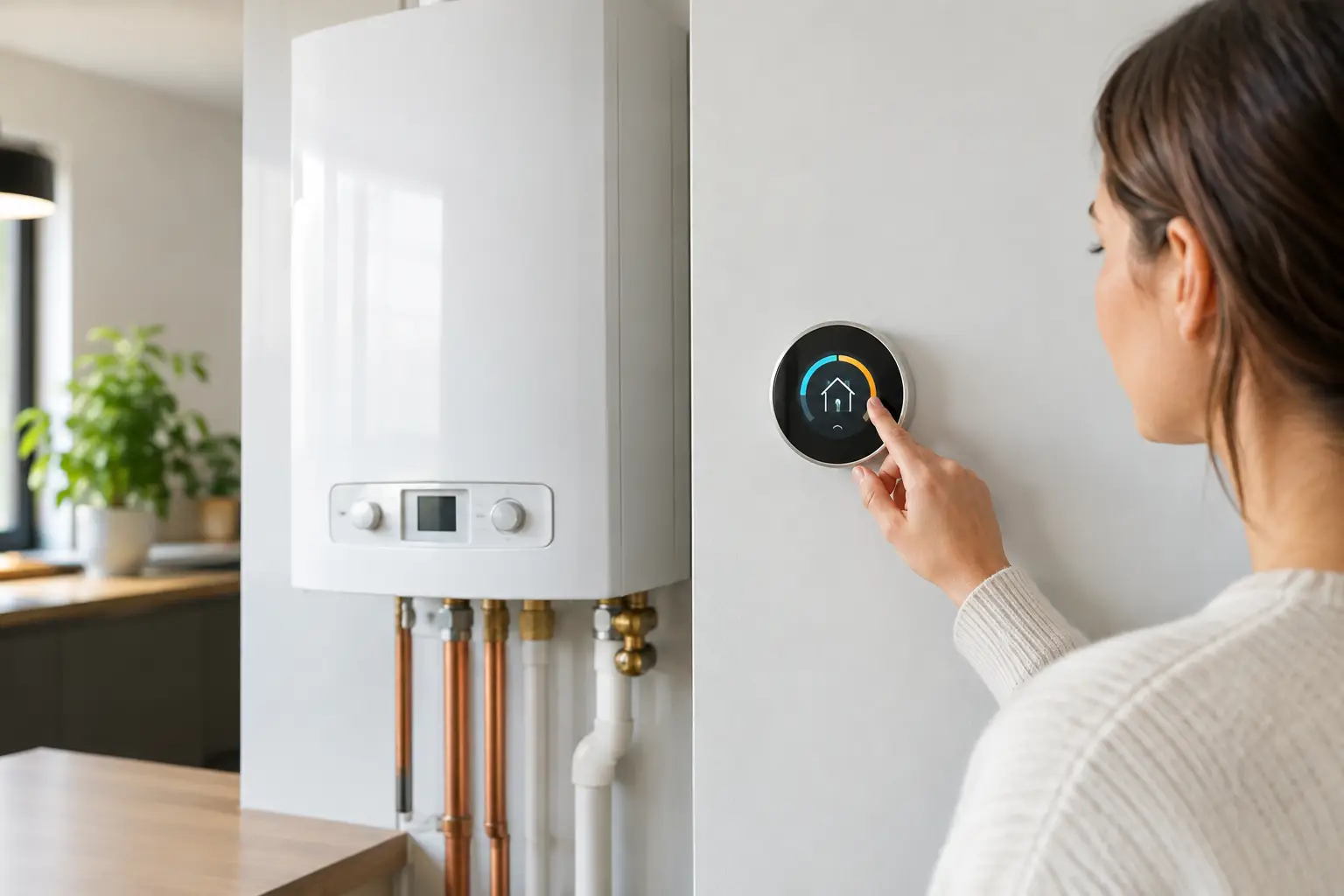
A smart thermostat with combi boiler can make your heating easier to manage, but the best results depend on more than choosing a well-known thermostat. Your boiler, existing controls, wiring and how your household uses heat all affect whether the upgrade saves energy, improves comfort, or simply adds another app to your phone.
For many Hertfordshire homeowners, the appeal is straightforward: turn the heating down when the house is empty, warm it up before you return, and avoid heating rooms unnecessarily. A properly specified system can do exactly that. The key is making sure it communicates with your boiler in the right way.
What a smart thermostat does with a combi boiler
A combi boiler provides heating and hot water directly from the boiler. Unlike a conventional system, there is usually no hot water cylinder to programme. That means a smart thermostat mainly controls your central heating, while hot water is supplied on demand when you open a tap.
Most smart thermostats connect to the boiler through a receiver, replacing or working alongside an existing room thermostat and programmer. From there, you can adjust the temperature from the thermostat itself or an app, set schedules and, on many models, use features such as geofencing, weather compensation or room-by-room control.
The practical benefit is control that fits around real life. If you are delayed getting home, you can change the schedule rather than heating an empty property. If you work from home in one room, a compatible system may let you heat that space without running every radiator at full demand.
However, a smart thermostat cannot cure a poorly performing heating system. If radiators are cold at the top, the system is sludged up, boiler pressure keeps dropping, or the boiler is unreliable, those issues need attention first. Controls improve how a sound system operates – they are not a substitute for servicing, repairs or a correctly sized boiler.
Is every smart thermostat compatible with a combi boiler?
Not necessarily. Many smart thermostats can be fitted to combi boilers, particularly when the boiler uses standard on/off control. But compatibility is not just a matter of whether the boiler fires up.
A basic relay thermostat tells the boiler to turn on or off when the room temperature falls below or rises above the set point. This can work well and is often a worthwhile step up from an old manual thermostat. Yet some modern boilers can do more when paired with compatible controls.
Modulating controls can make a difference
A boiler with modulation can reduce its output as your home approaches the requested temperature. Rather than repeatedly firing at high output and stopping, it can run more steadily at a lower level where conditions allow. This may improve comfort and efficiency, particularly in a well-balanced heating system.
Manufacturers use different communication methods. Some boilers and controls can work through OpenTherm, while others use their own manufacturer-specific protocol. A generic smart thermostat may operate a boiler perfectly safely through an on/off connection, but it may not access its full modulation capability.
This does not automatically mean you must choose the boiler manufacturer’s own control. A third-party smart thermostat may offer features that suit your household better. It does mean the decision should be based on how your particular boiler and controls work together, rather than on the thermostat’s online reviews alone.
Older boilers and existing wiring need checking
Older boilers may have fewer connection options, and the location of your current thermostat can affect installation. Some systems use wired controls; others need a wireless receiver fitted near the boiler. A mains supply may also be required for the receiver.
The boiler casing and its electrical connections should not be treated as a DIY project. Work around a gas boiler must be assessed and carried out appropriately by a qualified Gas Safe registered engineer. A professional installer can confirm compatibility, protect your boiler warranty and leave the controls correctly commissioned.
Smart thermostat features worth paying for
The right feature set depends on your home, rather than the longest list on the box. For a busy household, app scheduling and holiday mode can be genuinely useful. For a small flat with a simple heating routine, a reliable programmable thermostat may deliver much the same day-to-day benefit for less cost.
Look at whether the thermostat provides clear temperature control, easy scheduling and alerts if the heating drops unexpectedly. Frost protection is particularly useful for landlords and owners of empty properties during cold weather. Some systems can also report energy use, although these figures should be treated as an indication rather than an exact bill forecast.
Room-by-room heating is another popular option. This normally involves smart radiator valves, not just a smart thermostat. It can be helpful in larger homes, properties with unused bedrooms, or houses where one room is consistently warmer than another. There is a trade-off: more devices mean a higher initial cost, more batteries to maintain and more settings to manage.
Voice control can be convenient, but it should not be the reason for choosing a system. The fundamentals matter more: compatibility, a stable connection, simple controls for everyone in the property, and correct installation.
Before fitting a smart thermostat with combi boiler
Start by identifying the boiler make, model and age. Check whether there is an existing thermostat, programmer, smart control or wired receiver. A photo of the controls and boiler data plate can help an engineer understand what is already installed before attending.
It is also worth considering where the thermostat sits. If it is in a draughty hallway, beside a heat source or in direct sunlight, it may not reflect the temperature in the rooms you use most. Moving a thermostat is possible in some homes, although cable routes, wireless signal strength and the layout of the property must be considered.
Your radiator system should be in reasonable order too. Thermostatic radiator valves should not all be turned down in the room where the main thermostat is located, as this can stop the boiler before other areas have warmed up. A heating engineer can advise on balancing and control settings, especially where some rooms are slow to heat.
Finally, think about your broadband. Many smart functions rely on a dependable Wi-Fi connection. The heating will usually continue to operate locally if the internet goes down, but app access and remote changes may be unavailable until the connection returns.
Getting the settings right after installation
A smart thermostat is only as useful as its schedule. Set temperatures that are comfortable and realistic, rather than asking the system to make large changes several times a day. Constantly raising and lowering the target temperature can be less effective than using a steady routine suited to your household.
For most homes, it makes sense to schedule heating around wake-up times, work patterns and bedtime, then refine it over the first couple of weeks. If your property heats slowly, set the programme to come on earlier rather than setting an unnecessarily high temperature. If it heats very quickly, you may be able to shorten heating periods.
The boiler flow temperature also matters. On a condensing combi boiler, a lower flow temperature can often help the boiler operate more efficiently, provided your radiators still heat the home adequately. This should be adjusted carefully, particularly in older or larger properties, and reviewed with an engineer if you are unsure.
When professional advice is the sensible choice
A smart control upgrade should feel straightforward, not stressful. If you are replacing an old thermostat on a modern boiler, the work may be relatively simple. If you have intermittent faults, an ageing boiler, multiple heating zones or a system that has never heated evenly, an assessment first can prevent money being spent in the wrong place.
Walsh Plumbing & Heating can help homeowners understand which controls suit their boiler and how to get the best from the wider heating system. You pay what you are quoted, with no hidden costs, and the aim is always a solution that works reliably after the engineer has left.
A good smart thermostat should fade into the background: your home is warm when you need it, your heating is not running when you do not, and the controls are simple enough that everyone can use them. That is the standard worth choosing for.